R.D. Mehta (1849-1930): A Leading Calcutta Parsi

This October, the Calcutta Parsi community will conclude year-long celebrations for the hundredth anniversary of the Ervad Dhunjeebhoy Byramjee Mehta’s Zoroastrian Anjuman Atash Adaran, the only functioning fire temple in the city and one of two fire temples in eastern India (the other is located in Jamshedpur). In November 2011 I was invited by the community to give an address on Rustamji Dhanjibhai (R.D.) Mehta (1849-1930), a prominent leader of the community whose generous financial contributions enabled the fire temple to be built. This short article will briefly consider R.D. Mehta’s life and career, including some interesting documents that I have found in the Dadabhai Naoroji Papers in Delhi. A longer article on R.D. Mehta and the Calcutta Parsi community will appear in the agiary’s souvenir publication, to be produced later this year.

Image from the Cyclopedia of India, vol. 1-2 (Calcutta, 1907).

R.D. Mehta was born in Bombay to a family that already had Calcutta connections: his father, Dhanjibhai Byramji (D.B.) Mehta (1826-1907) was based in the city due to his involvement in the “China trade”—a loose euphemism for the opium trade—and in 1860 he decided to relocate his entire family to the eastern metropolis of India. After completing his schooling, Mehta was first apprenticed to an Armenian trading firm (Parsis enjoyed close connections with the city’s prosperous Armenian community) before joining his father’s company. As the China trade began to slacken, R.D. Mehta helped reorient the family business: having secured special equipment and machinery from England, in 1878 he helped set up the first truly modern cotton mill in Calcutta, the Empress Mills, located upriver from Calcutta in Serampur. The common belief in Calcutta was that this expensive, highly-technical mill would be a commercial flop. Empress Mills, however, soon became a roaring commercial success, helping diminish Bombay’s absolute hegemony in the cotton industry. The Mehta’s later diversified into jute as well. Evidence of their commercial success is found in—of all places—the New York Times. In an article on the Parsis, published on 12 October 1902 under the headline “Millionaires of the Orient,” the Times declared “The Petits and the Wadias had captured the cotton on the Bombay side. It remained for the Mehtas to cross over to the Bengal side and capture the jute.”

In 1890, D.B. Mehta, by all accounts a very pious Zoroastrian, decided to set up a private dar-i-meher at his residence at 65 Canning Street, located in north-central Calcutta. Priests from either Bombay or Navsari (there are two differing versions) carried the alat—ritual implements—by foot across the subcontinent. There was already a functioning fire temple in Calcutta, the Banaji family temple (1839) located close by on Ezra Street, but, as I’ve stated in an article shortly to be published, there appeared to be some definite rifts between the Mehta and Banaji families. In any case, D.B. Mehta had long expressed his wish to establish an agiary for the public. After he passed away in 1907, R.D. Mehta and his widowed mother donated a liberal sum—and collected additional funds from the community—to erect a grand structure on Metcalfe Street in Bowbazaar. The foundation stone of the atash adaran was laid on Sunday, 17 September 1911, heralding a new chapter in the history of the Calcutta Parsis.

Today, R.D. Mehta is primarily remembered for his connection with the agiary as well as for the trust in his name. What is less known is that, from the 1880s until the early 1900s, Mehta played a prominent role in emerging nationalist politics in Bengal. While sifting through the Dadabhai Naoroji Papers in the National Archives of India, I have come across several letters between Naoroji and Mehta. Mehta, it appears, functioned as a right-hand man of sorts for Naoroji: Naoroji utilized Mehta’s connections with the Bengali elite in order to coordinate political activities. In 1885, for example, when the new secretary of state for India, Lord Randolph Churchill (Winston’s father), visited Calcutta, Naoroji reached out to Mehta in order to encourage a formal meeting between Churchill and prominent Calcutta citizens. Similarly, Naoroji communicated with Mehta about a British politician or journalist planned a visit to the capital of the Indian empire. In many ways, Mehta was an important conduit between the Bengali political elite and Naoroji—and, through Naoroji, the Bombay political elite.

Included below are some interesting few letters from the Naoroji-Mehta correspondence:

1. R.D. Mehta to Dadabhai Naoroji, 29 January 1885

D.B. MEHTA & Co.

CALCUTTA.

55, Canning Street

29th January 1885

My dear Sett Dadabhai

You will kindly accept my most sincere thanks for your favor of the 21st instant.   I had circulated your letter amongst a number of my friends who I assure you have read with intense pleasure & interest.  We are organising an Evening Party at the India Club for Lord Randolph [Churchill] & have telegraphed for his consent.  No reply is yet received but there is no fear of his refusing the invitation.  An attempt is also made to secure a private interview with him.  Do you think we might impress on Lord R’s mind the desirability of admitting natives to the Commissioned ranks of the Military Service?  If I could be of any use to you here I would indeed be very glad.  Some time ago you wrote to me 2 or 3 letters in connection with the “Voice of India” & I was extremely sorry for not replying to them, & I am sure you will excuse me when I tell you that my father was very sick at the time, in fact his condition was most precarious, & owing to that cause I was not in a fit state of mind to attend to any business.  Mr. [Allan Octavian] Hume has written a letter to Narendra Nath Sen & the question of establishing telegraphic service with England weekly is on the carpet.  What do you think of Lal Mohun Ghose’s candidature for the Parliament?  I sincerely wish that he gets in, he or any one from India if once gets in the Parliament then I think the time has fairly come for India to raise a hue & cry for having representative parliaments Councils.  The matter then should be agitated thro’ the length & breadth of India & not allowed to drop till we have gained our points.

With my best wishes for your health & happiness.

Believe me

Ever Yours Sincerely

R.D. Mehta

Dadabhai Naoroji Esq.

5th Khetwady Lane—Bombay

Lal Mohun is a good speaker no doubt, but he lacks in figures & unless he makes that his special study he will not be very successful.

2. R.D. Mehta to Dadabhai Naoroji, 5 March 1885.

THE EMPRESS OF INDIA COTTON MILLS Co. Ld.  CALCUTTA.

55, Canning Street,

Calcutta, 5th March 1885

My dear Mr. Dadabhai

I owe you apologies for not having sooner answered your very kind letter.  Lord Randolph beyond visiting Sir Jotindro Mohun Tagore at his private residence did not accept anybody’s invitation nor did he grant any interview.  But from the little we saw of him we found him to be a man full of information upon almost every topic.  We expect Mr. Hume here shortly.  He will be the guest of Mr. Nundmohun Ghose,—Lallmohun’s Brother.  It is the intention of our Bengalee Friends to establish a weekly or fortnightly telegraphic service between here & England independently of Bombay, & with that in view they have I think succeeded in securing some Rs. 20.000.  It is a great pity that our aristocratic class remain quite aloof from the Reformed Party, & do not give their desired support.  Our Lieutenant Governor seems to enjoy their confidence & his advice they act upon.  The public utterances of our Governor are beyond all question hostile to the native community & in spite thereof I cannot understand why our rich Zemindars should cling to him.  The Europeans are beginning to dislike our present Viceroy who they fear is more for the Natives than for his own class.  I am afraid he will retire with the change of the Ministry.

Enclosed please find my subscription—No. M68 55013 Bombay 1st August 1881 for Rs. 10—to the Voice of India for the Current Year.

Trusting you are keeping good health & with kindest regards

I am, Yours Sincerely

R.D. Mehta

            How is your son Ardesir?  Has he got over that defect in the leg?

To Dadabhai Naoroji Esq.

Ketwady [sic] 5th Lane

Bombay.

3. 24 September 1906, R.D. Mehta to Dadabhai Naoroji. The letter refers to the moderate-radical split in the Congress as well as to Naoroji’s recent acceptance of the presidency of the Congress for its 1906 session in Calcutta. 

55, CANNING STREET,

CALCUTTA.

24th Septr. 1906

My dear Seth Dadabhai

We are pleased to learn that you have accepted the Presidentship of this year’s Congress.  The Bengalees are fighting among themselves & any one & every one poses as a Leader.  In the lot we have some very good men & some self seeking.  I am sure your presence would tend to settle the matter down smoothly.  We will take it as a great favor if you will put up with us as you so very kindly did on your last visit.  Pray accept this as an invitation from my dear old parents & all of us.  We would not say how very pleased we would be to put you up and to show you your likeness gracing and ornamenting our agiary.

By last mail I have sent my fifth son Khusroo for medical tuition with his eldest brother Maneck, the barrister whom I dare say you know.  My barrister son Maneck aspires to a Judgeship of an High Court & I have to solicit your kind help in the matter.  Need I say how grateful we all would be by our helping him & putting him in the way.

I sincerely trust you are keeping well & with our united kindest regards & best wishes,

I am,

Yours Sincerely,

R.D. Mehta

Further Reading:

Jesse Palsetia, “Parsi Communities ii: in Calcutta,” Encyclopaedia Iranica.

Review: Amitav Ghosh’s River of Smoke

Amitav Ghosh, River of Smoke (Delhi: Penguin, 2011). 558 pp.

A popular (and very inaccurate) version of Parsi history in India posits the community’s relative obscurity until around the 1700s, when an influx of enterprising Parsis into Bombay—by sheer dint of their hard work and enterprise—brought undreamed of wealth, political influence, social capital, and respect to their tiny community. We are all familiar with the stories of poor moffusil Parsis who lifted themselves out of desperate poverty and established themselves as honest, trustworthy, civic minded individuals, lavishing their fortunes on philanthropic causes and the improvement and adornment of western India’s great metropolis.

There is, of course, a measure of truth in this narrative. What is less acknowledged—both inside and outside of the community—is that a good portion of this wealth until the 1850s was built on opium, and specifically the exportation of opium to China. The so-called “China trade” was, in reality, largely constituted of the smuggling of narcotics. During the first three decades of the nineteenth century, as the scholar Amar Farooqui has demonstrated in his book Opium City (2006), Parsis controlled approximately one-third of the firms in the city that dealt in the opium trade. Many of the most prominent, respectable Parsi families—the Readymoneys, Jeejeebhoys, Wadias, Banajis, Camas, and the Tatas—rose to fame and fortune partly or fully through opium. It is a dark aspect of Parsi history that the community has, for the most part, found it very difficult to acknowledge, leave alone address.

In this light, Amitav Ghosh’s new novel, River of Smoke, the second part of his Ibis trilogy, is an important book. It delves into the Parsi involvement with the opium trade and the many ways this helped create the modern community as we know it. Parsis would be well advised to read Ghosh’s novel—a fictional account premised on voluminous historical research—in order to gain perspective on how some of our ancestors grew rich off the sufferings of a faraway land.

Following up on Sea of Poppies, Ghosh centers his story around Bahramji Modi, a Parsi trader who bears striking resemblance to Jamsetji Jeejeebhoy. Like Jamsetji, Bahram is born into relative poverty in Navsari but rises quickly to commercial success after marrying into a wealthy family—the Mistries, heirs to a shipbuilding empire. As contracts for ships wane, Bahram advises his father-in-law to diversify into new commercial opportunities. “Today the biggest profits don’t come from selling useful things: quite the opposite,” he argues. “The profits come from selling things that are not of any real use. Look at this new kind of white sugar that people are bringing from China—this thing they call ‘cheeni.’” Opium, Bahram continues, “is just like that. It is completely useless unless you’re sick, but still people want it” (p. 51).

Fast-forward to 1838: Bahram, having long ago convinced his father-in-law and—thereafter— reaped incredible fortunes from his decades in the “China trade,” set out for Canton carrying his most valuable—and, from the standpoint of his business interests in Bombay, most critical—shipment of opium. Ghosh paints a vivid picture of Canton and its foreigners’ enclave, “Fanqui town.” While the walled Chinese city remains forbiddingly inaccessible, Fanqui town is a whirl of people from all over the globe—Indian lascars, British and American opium barons, Eurasian painters, Cantonese beggars, scraggly European sailors—all packed into a few tiny blocks. And then there is the Pearl River itself, the “greatest of Canton’s suburbs,” clogged with houseboats, one of which housed Bahram’s beloved Chinese mistress, whom had borne him a son, Freddy or Ah Fatt. Now one of Fanqui town’s most prominent seths, an arbiter of Indian interests and a close friend of the biggest British and American traders, Bahram hastens back to a city that has transformed his life markedly for the better. But all is not well: rumors swirl of an impending Chinese crackdown on the opium trade, one designed to sweep away the atmosphere of graft, payoffs, and broad-daylight smuggling in which the opium trade has flourished.

Much on the novel focuses on a very different conflict: the struggle of Bahram and his fellow merchants to convince themselves that they are simply law-abiding merchants, washing their hands of any hint that their trade transgresses legal or moral boundaries. Smuggling opium, indeed, is a very non-Zoroastrian activity: the pious Parsi would shun association with a substance that pollutes both fire and the body. But Bahram resolutely defends his chosen profession. “…[I]t is not we but the Chinese who are responsible for the trade,” he argues with a fellow member of the Canton Chamber of Commerce. “It is they who love opium after all” (p. 387). Occasionally, however, his conscience is pricked. During a chance meeting with Napoleon Bonaparte, now reduced to tending a small garden on his prison island of St. Helena, the ex-emperor catches Bahram unawares by asking him point-blank if he thought the opium trade was evil (pp. 174-75). Once the members of the Chamber of Commerce are confronted by official orders by the new Chinese commissioner in Canton, Lin Zexu, to give up their opium stock and renounce future involvement in smuggling, the Chamber’s lone voice of conscience frames the issue much more bluntly for Bahram. “Think not of this moment but of the eternity ahead,” he cautions Bahram before a vote on compliance with Lin’s edict. “Who will you choose, Mr. Moddie? Will you choose the light or the darkness, Ahura Mazda or Ahriman?” (p. 470)

Obfuscating morality is a much easier task for many of Bahram’s British colleagues, including William Jardine (who, in real life, had Jamsetji Jeejeebhoy as a major business partner) and Lancelot Dent. Ghosh highlights how such men deployed arguments of “free trade” in order to legitimate their activities—and eventually pave the way for British military action against China during the First Opium War. By transporting opium from India to China, Jardine and his ilk maintained, opium smugglers were simply obeying the laws of supply and demand; Chinese attempts to cut off supplies, furthermore, were nothing more than gross, barbarous interferences with British and American commercial liberties. “We are not smugglers, gentlemen!” Jardine roars to an appreciative crowd. “It is the Chinese government, it is the Chinese officers who smuggle and who connive at and encourage smuggling, not we; and then look at the East India Company: why, the father of all smuggling and smugglers is the East India Company!” (p. 405)

The Indian angle is important. Ghosh’s novel addresses a fundamental paradox in the opium trade for the Indians who were involved in it. The East India Company’s laxity with opium exports meant that a handful of Indians did grow fabulously rich in the early 1800s. But what were the costs? Both the Company and British firms, of course, captured the overwhelming majority of the profits. Most Indians, meanwhile, suffered double humiliations in Canton: second-class status in comparison to Europeans and American residents, as well as the glowering contempt of Cantonese who resented India’s and Indians’ role in the opium trade. But an even bigger humiliation was the fact that, under the juggernaut of British imperialism, the smuggling of narcotics was one of the only avenues open to Indians for personal and material advancement. It was an enterprise that cut at the foundations of India’s moral economy and commercial economy while creating only a very select few Jeejeebhoys, Muhammad Ali Rogays, and Roger de Farias. It was clearly an evil system. This is a realization that slowly dawns on Bahram as the events of early 1839 unfold.

As usual, Ghosh has assembled a massive array of sources—on topics ranging from Chinese and Indian history to botany and the pidgin dialects spoken in Fanqui town—which add real historical depth and dimension to River of Smoke. He has also done an admirable job in researching the Parsis. When Bahram dines, he enjoys a selection of akuri, aleti paleti, dar-ni-pori, and various other items par eeda; when he dresses, he puts on the turban and angarkha that distinguished Parsi gentlemen in the early 1800s; and when he speaks, it is with speech patterns, idioms, and phrases that many Parsi readers will immediately recognize. In his Parsi characters, Ghosh has splendidly brought to life the Parsi Gujarati dialect, teaching me some phrases that I need to deploy in daily speech (tukki garden valo haramjada ni nisani—“a short neck is a sure sign of a haramzada.” Wise words indeed!). There are some very minor, relatively insignificant historical errors. Symbols such as the farohar or the now-familiar portraits of the Prophet Zarathushtra were quite uncommon in 1830s Parsi society (as for the portraits, see an interesting essay written by Dan Sheffield on the subject, forthcoming in the Journal of the K.R. Cama Oriental Institute). Similarly, Bahram’s ship, the Anahita, has Persepolis-style decorations that also would have been relatively uncommon in that era: such styles only gained popularity in the community around the very end of the nineteenth century.

But these are infinitely minor details. River of Smoke is a gripping account of how an array of Indians, Chinese, and Europeans—Parsis, Bengalis, Indo-Portuguese, Scotsmen, a French girl; seths, merchant princes, botanists, dubashes, smuggler agents—were brought together and convulsed in the months before British guns opened fire in the Pearl River Delta.  It is a welcome work of literature that will hopefully tackle collective historical amnesia over a significant yet sordid chapter in both Parsi and Indian history.

Request for Assistance: Tracing Dadabhai Naoroji’s Descendants

I would like to ask readers for assistance in helping trace any descendants of Dadabhai Naoroji.

Letter to Dadabhai Naoroji by his young grandson, Sarosh. Dadabhai Naoroji Papers, National Archives of India, Delhi.

Dadabhai Naoroji, who was married to Gulbai Shroff (b. 1829?) at an early age, had three children: Ardeshir (1859-1893), who married Virbai Dadina; Shirin, who married Fram Dadina; and Manekbai or Maki (b. 1868), who married Homi Dadina. We know that Ardeshir and his wife had eight children: Perin (Captain), Nurgis (Captain), Kershasp, Jalejar or Jal, Gosi, Meherbanoo or Meher, Sarosh, and Khorshed. Sadly, none of Naoroji’s grandchildren had any children themselves, and therefore this branch of Naoroji’s family went extinct.

At the moment, I do not know much about Naoroji’s descendants through his daughters, Shirin Dadina and Maki Dadina.  I know that Maki and Homi had at least two sons, one of whom was an AH Dadina, who was still alive in 1970, when he wrote a letter to Parsi Avaz (I thank Ervad Marzban Hathiram for bringing this to my attention). They were made navars in 1915 in memory of their grandmother, Gulbai. Unfortunately, this is all I know of any possible Naoroji grandchildren through his two daughters. Maki (who was trained in England as a doctor) and Homi lived with Naoroji at Versova until his death and Shirin and Fram spent some years in Karachi, most likely returning to Bombay thereafter.

I would greatly appreciate it if anyone could supply me more information on these two branches of the Naoroji/Dadina families, as well as any other relations of Dadabhai Naoroji. I hope to construct a Naoroji family tree building on what RB Paymaster sketched in his book, A Farman of Emperor Jehangir Given to Dr Dadabhai Naoroji’s Ancestors Three Centuries ago and a Short History of His Dordi Family of Navsari, published in 1925. I would also welcome any information from Dordi family members who can trace ancestry to Naoroji.

I can be contacted at dinyar.patel@gmail.com.

Many thanks,

Dinyar Patel

2012 Iranian Studies Conference in Istanbul

Galata Tower and Beyoglu across the Golden Horn as seen from Eminonu, Istanbul.

Last week, the International Society for Iranian Studies (ISIS) held its biennial Iranian Studies Conference in Istanbul, attracting over four hundred professors, graduate students, and other researchers involved in the study of Iranian history, politics, religion, literature, and culture. Istanbul was an appropriate venue: for centuries, the region has had political, economic, and cultural links with Iran. Herodotus tells us that Darius the Great built a pontoon structure across the Bosporus’ narrowest point, probably somewhere near the present-day Second Bosporus Bridge (incidentally, this is also where the Ottomans built a strategic fort, Rumeli Hisari, for launching their invasion of Constantinople). Anatolia was under Persian control for much of the Achaemenid Empire. In more recent times, the Turks, while embroiled in military and religious disputes with empires to the east such as the Safavids, participated in a broad exchange of culture and literature with Iran, perhaps best represented in individuals such as the Sufi mystic Rumi. Istanbul has, historically, also hosted a large and vibrant Iranian community.

Perhaps more so than many other regions, it is impossible to study Iran without looking at the cultures and societies that border it. At this year’s ISIS conference, I was privileged to be a part of a panel that explored relations between India and Iran. Moreover, our panel looked specifically at the Parsi Zoroastrian connection, evaluating how Parsis, and certain Parsi individuals, helped shape some contours of recent Iranian history. Our panel chair—the distinguished Oxford historian Homa Katouzian—assisted in framing our research within broader historical themes such as the development of Iranian nationalism in the late nineteenth and early twentieth century. We were very fortunate to have in attendance the “grand old man” of Iranian studies, Professor Ehsan Yarshater (Columbia University emeritus), who, at the age of 92, shows few signs of slowing down or restricting the scope of his academic activities.

Two of our papers approached their subjects from the perspective of Iran and Iranian society. Monica Ringer, associate professor at Amherst College, spoke about Kaikhosrow Shahrokh’s reforms of funerary customs among Iranian Zoroastrians. Shahrokh, a Zoroastrian from Kerman and the most prominent Iranian Zoroastrian leader in the 1920s and 1930s (he was the Zoroastrian representative in the Majles, the Iranian parliament, until his death), introduced cemeteries in 1935 and dissuaded the use of dakhmas. Shahrokh’s justification for this reform, Ringer argued, was threefold:  invoking modern science, he claimed that burial was more hygienic; relying upon religious texts and contemporary scholarship, he postulated that dakhmas were not “authentic” since they were not enjoined by Zoroaster; and finally, giving the expanding nature of cities like Tehran, he pointed out that dakhmas would soon be swallowed up by urban growth. These funerary reforms, Ringer concluded, constituted an important moment for the Iranian Zoroastrian community: it represented a clear break with Parsi custom, which had predominated since the time of Manakji Limji Hataria.

Manakji, incidentally, was the topic of a paper presented by Reza Zia-Ebrahimi, a senior lecturer at Sheffield Hallam University in the United Kingdom. Many Parsis are aware that Manakji played an extremely important role in the late nineteenth century in ameliorating the conditions of the Iranian Zoroastrians, helping establish schools and lobbying for the elimination of the jizya tax placed on non-Muslims. What is less known, however, is Manakji’s significant influence on Iranian nationalism. Zia-Ebrahimi noted that Iranian nationalism, formulated between the 1850s and 1870s, revolved around the belief that the country had fallen from glory and power since the Arab Muslim conquest in the seventh century. The nationalist ideology promoted by individuals such as Fathali Akhunzadeh and Jalal ed-din Mirza, which argued for reviving Iran’s past greatness, was therefore decisively anti-Arab and anti-Muslim.  As a Parsi Zoroastrian with a deep conviction of the glory of ancient Iran, Manakji became an “object of fascination” for such nationalists, buoying a belief that Zoroastrianism was intrinsically linked to Iran’s supposed golden age. Manakji was an active participant in the promotion of this nationalism, as well: he wrote and disseminated texts on Zoroastrianism and ancient Iran and had a wide network of contacts within Iran’s intelligentsia.

Both Afshin Marashi’s paper and my presentation concentrated on the Indian side of the Parsi connection with Iran. Marashi, a professor at the University of Oklahoma, spoke on Dinshah Irani, who worked quietly behind the scenes to promote Indo-Iranian educational and cultural exchange in the early twentieth century. Irani, a Bombay-based solicitor keenly interested in the welfare of the Iranian Zoroastrians and Iran itself, was directly and indirectly responsible for the dissemination of much Zoroastrian scholarship among the Iranian reading public. Aside from his own works, Irani was an early supporter of Ebrahim Purdavud, a prolific scholar of Zoroastrianism who rendered the Avesta into modern Persian and also published Iranshah, a book on the history and achievements of the Parsis of India.

Irani is an important figure in my research on the Iran League of Bombay. My presentation, based on detailed reading of the organization’s publication, the Iran League Quarterly, between 1930 and 1941, examined the ways that Parsis tried to promote cultural, economic, and educational links with the country that we regard as our ancient motherland. Individuals such as Irani and G.K. Nariman promoted scholarship that stressed the common ancestry and history of Indians and Iranians while working to decrease anti-Muslim sentiment among Zoroastrians and anti-Zoroastrian sentiment among Muslims. Others labored to promote Parsi tourism in Iran and also advocated Parsi investment in the Iranian textile and manufacturing sectors. As the 1930s progressed, however, League members became increasingly drawn toward the brand of nationalism promoted by the Reza Shah and even advocated the Parsis’ “return” to Iran. Such rhetoric, I believe, was the result of growing Parsi disillusion with the Indian National Congress in the 1930s: authoritarian Iran seemed appealing to many as British India was convulsed by mass-based nationalism. Parsi illusions of Iran under the Pahlavi regime came crashing down in the early 1940s, first by the assassination of Kaikhosrow Shahrokh and later by Reza Shah’s removal from power in 1941.

Several other panels and presentations were on topics relevant to the study of ancient Iran and Zoroastrianism. Two panels were devoted to evidence of the Achaemenid Persian presence in Anatolia, drawing on literary, archeological, and architectural sources. Shervin Ferridnejad (University of Göttingen) and Manya Saadi-nejad (Concordia University) both spoke on how religious texts—ranging from the Yashts to Pahlavi literature such as the Arda Viraz Namag (Ardaviraf Nameh)— described and portrayed the physical appearance of Ahura Mazda and yazatas such as Anahita. Alberto Cantera, professor at the University of Salamanca and director of the Avestan Digital Archive, put forth the case for creating a new edition of the Avesta (the last edition of the Avesta in a modern language was done by Karl Geldner in the 1890s), citing as one reason the recent discovery of many Zoroastrian manuscripts in Iran (thus also disproving the notion that Iranian Zoroastrians gave up all their texts to the Parsis by the early 1900s).  Mehmet Alici, a Turkish Kurdish scholar, provided a fascinating glimpse into the celebration of nowruz in Turkey, pointing out that it was a state-supported festival under the Ottomans, who had their own version of the haft-sin (which included the simit, or bagel). While state support of nowruz ended in 1908, the festival has enjoyed a revival in Turkey since the fall of the Soviet Union, where it has been used to celebrate Turkic cultural connectivity with the new Central Asian republics.

Finally, Professor Richard Foltz of Concordia University spoke on topics that have created great controversy in the Zoroastrian community: conversion and the supposed proliferation of neo-Zoroastrianisms in Iran and abroad. Foltz, importantly, noted the extremely limited number of individuals in Iran and elsewhere who have actually elected to convert to Zoroastrianism, providing more evidence against the widespread Parsi belief that Iran and Central Asia are burgeoning with individuals desirous of embracing the faith. In a recent visit to Tajikistan, for example, Foltz was struck by how little interest or knowledge that ordinary Tajiks displayed in Zoroastrianism; indeed, he left the country with the belief that it was experiencing a pronounced Islamic revival. State rhetoric, which has stressed Tajikistan’s Zoroastrian roots and culture, has been at complete odds with public sentiment. Like many other scholars, Foltz expressed concern about Zoroastrianism’s survival among its current adherents, regretting the litany of controversies that have embroiled the Parsi and Iranian Zoroastrian communities. We Zoroastrians would be well advised to recognize such scholarly opinions, reassess our priorities, and promote community concord as our worldwide numbers continue to shrink.

One unfortunate development detracted from the overall success of the ISIS conference. In the weeks leading up to the event, Kayhan, a state-supported Iranian newspaper, lashed out at ISIS and its conference, accusing them of being “Zionist and monarchist” and promoting Baha’ism.  Furthermore, the paper issued not-so-veiled threats that any Iranian academics attending the conference would lose their jobs. Turkey is one of the few countries where Iranian nationals can travel to without a visa; a conference in Istanbul, therefore, would have provided a welcome opportunity for large-scale representation from the Iranian academic community. Sadly, Kayhan’s actions resulted in nearly all the Iranian participants deciding to pull out of the conference. A few non-Iranian scholars, not wishing to antagonize the Iranian government, also dropped out.

Victoria’s Diamond Jubilee: Jashan at Wadia Atash Behram, 20 June 1897

As I have written in an article recently published in The Hindu, the last time that a diamond jubilee was celebrated by a British monarch–Queen Victoria in 1897–was an especially significant moment in Indian history. The jubilee was marked in a variety of ways by different communities. The Parsi community in Bombay held a public meeting in April 1897 in order to deliver speeches and finalize a congratulatory memorial that was to be dispatched to Victoria.

Almost 115 years to the date, on 20 July 1897, around two-hundred Parsi priests, including some of the most eminent priests of the time, packed into Wadia Atash Behram in Bombay in order to hold a special jashan for the queen. While it is tempting to see this ceremony entirely in light of Parsi Anglophilia of the time, the jashan was not without historical precedence. Monarchy has always been an important institution within Zoroastrianism, and during the ancient Persian empires reverence and loyalty toward the ruling monarch was considered an especially important virtue. Several Parsis in 1897 commented on how the jashan for Victoria was similar to prayers of thanksgiving offered to Persian Zoroastrian monarchs of the past.

Below is an excerpted article from the Times of India for 21 June 1897, covering the jashan at Wadia Atash Behram.

THE PARSEE THANKSGIVING CEREMONY.

In response to invitations of the Trustees to the Parsee Punchayet Funds, over one thousand Parsees, and about 200 Parsee priests among them, assembled yesterday afternoon in the hall of the Wadia Atashbehram at Dhobi Talao, for the purpose of offering special prayers on the occasion of the Queen-Empress’s Diamond Jubilee. Four Dastoors, namely, Jamasji Minocherjee, Peshotanjee Beheramjee, Khorshedjee Bejonjee, and Dossabhoy Sorabjee, (the latter gentleman being a representative of the Meherjirana family of Navsari), officiated at the ceremony, in the celebration of which the whole of the Parsee priests present, and most of the laity, took part. Among those present were:–Sir Dinshaw M. Petit, Bart., Mr. Hormusjee Edaljee Allbless, Shams-ul-Ulma Ervad Jivanjee J. Modi, Mr. D.R. Chichgar, Ervad Edaljee Kersaspjee Antia, Mr. Nowrojee J. Gamadia, Mr. Muncherjee H. Jagose, Mr. B.B. Patel, and Mr. K.R. Cama. After the Jasan ceremony was over, a special prayer in Zend, composed by Dastoor Peshotanjee, was offered, invoking blessings and happiness on her Most Gracious Majesty, the whole of the assembly standing during the time the prayer lasted. Ervad Jivanjee J. Mody, secretary to the Parsee Punchayet, then thanked the assembled gentlemen for having responded to the call of the Trustees of the Punchayet, and next proceeded to exhort the Parsee community in a stirring speech, delivered in Gujarati, for not only their their unflinching loyalty to their august Sovereign Lady the Queen-Empress, but to her representatives in Governments and Administrations, reminding them that, although comparatively speaking the Parsees were  a small community, they have enjoyed unparalleled prosperity and security during the sixty years of the Queen’s reign. These sentiments having been loudly applauded by the assembly, Ervad Jivanjee read the following telegram which will be forwarded in the name of the Parsee community of Bombay by Sir Dinshaw M. Petit, to Lieutenant-Colonel Sir A.J. Briggs, Private Secretary to her Majesty:–“Parsee community of Bombay assembled at their Fire-temple to say thanksgiving prayers on Jubilee Day, humbly beg leave to offer their loyal, heartfelt congratulations to her Majesty. May God bless her Majesty with health and happiness.” The message having been approved of by the whole of the Anjuman assembled in the Jasan, the proceedings were brought to a close amid cheers and demonstrations of joy.

India and the Last Jubilee Queen

Note: The following is an article published in The Hindu on 16 June 2012.

http://www.thehindu.com/opinion/lead/article3533400.ece?homepage=true

India and the last jubilee queen

DINYAR PATEL

The 1897 celebrations for Victoria proved to be an important turning point in the nationalist movement

Last week’s diamond jubilee celebrations in London, marking the 60th anniversary of Queen Elizabeth II’s reign on the British throne, garnered relatively limited coverage in the Indian media. While several British South Asians played a prominent role in the festivities, any Indian citizens in attendance were more than likely curious tourists. Amongst the hundreds of boats on the Thames was one carrying the Indian tricolour, which, flying amidst the flags of other Commonwealth nations, provided perhaps the only visible reminder that a British Empire even existed.

What a difference a century makes. As celebrations for Elizabeth continue, it is worthwhile to reflect on the last time that a diamond jubilee was celebrated. That was in 1897, when the aged monarch, Victoria, was also the Kaiser-e-Hind, the Empress of India. Consequently, India played a much bigger role in the jubilee, and the jubilee, in turn, had much greater significance for India. The jubilee was an important moment for India in two ways. Firstly, in an imperial system that placed great weight on public displays of loyalty, it gave various Indian communities an opportunity to jockey for political capital and recognition. Secondly, the jubilee presented a conundrum to Indian nationalists. How best to respond? How should congratulatory messages be balanced with political protest? Ultimately, this question helped widen fissures between emerging moderate and radical factions. By the time the jubilee festivities ended in late 1897, the radicals had proven themselves to be a force with which to be reckoned.

Addresses of loyalty

Victoria’s diamond jubilee was designed to demonstrate the strength and diversity of the British Empire. The festivities, which like Elizabeth’s, occurred under mercurial June skies, featured representatives from across the colonies, ranging from Dayaks from Borneo to Hausas from western Africa. Over forty thousand soldiers from all parts of the empire descended on London. Within India, British administrators sought to recreate a microcosm of this pomp and splendour. They invited delegations to present addresses of loyalty and thanks to the viceroy in the summer capital of Shimla. From across the subcontinent streamed in official representatives of the Hindus of Lahore, Khojas of Bombay, Awadhi taluqdars, and Muslim Bengali women.

Other Indians lost no opportunity for lavish and oftentimes servile demonstrations of their loyalty to the crown. Princes held darbars, fed thousands of poor people, and laid foundation stones for new hospitals and schools to be named after the queen. Prayer meetings were organised in temples and mosques across the country. Residents of Lahore argued over how best to erect a statue of Victoria. Two hundred Parsi priests packed into the confines of Bombay’s Wadia Atash Behram in order to deliver a special jashan prayer for the monarch. In Ajmer, dargah custodians pitched in to organise a large fair, while the Bene Israelis of Ahmedabad decided to collectively illuminate their houses. The Jains of Calcutta made what was perhaps the best use of an obligatory message of congratulation: they appealed to Victoria to ban all animal slaughter on her jubilee day. These memorials, darbars, festivals, and prayers were readily picked up by the British press, as well as by European papers in India, in order to reinforce the common belief that loyalty to British rule, alone, united India’s diverse and teeming multitudes.

But celebrations and flowery messages barely masked what was otherwise a dark year in Indian history. Famine had swept over much of the north and west, followed soon after by a major plague epidemic. These tragedies were compounded by the Raj’s relatively apathetic response to the famine and its imposition of draconian plague regulations. Leaders of the Indian National Congress, an organisation barely 12 years old, were at loggerheads as to how to balance declarations of loyalty with stern condemnation of British policy. At their December 1896 meeting in Calcutta, the Congress passed a feeble resolution congratulating the queen. This sent Henry M. Hyndman, the father of British socialism and an outspoken critic of British rule in India, into a fit of rage. ‘Congratulations for what?’ he asked his friend, Dadabhai Naoroji, in January 1897. ‘For having ruined India for two or three generations to come? It is pitiful.’

Hyndman’s relationship with Naoroji forms an important part of the story of India’s response to the jubilee. Naoroji was then in residence in London, where he had been agitating for Indian political reform. With increasingly horrific accounts of the famine and plague streaming in, Naoroji decided to throw in his lot with Hyndman’s Social Democratic Federation (SDF) and launch a series of protests and public meetings across Britain. Both men agreed that a steady drain of wealth and resources by the British were the root causes of India’s poverty and misery. They had both spent the last several decades clamouring for more Indian representation in the government.

But now their campaign took a much more radical turn, employing language that did not spare the Kaiser-i-Hind. The silver jubilee, Hyndman told a mass meeting that he organised with Naoroji in February, should be celebrated in a manner befitting a monarch who had been ‘the Empress of Famine and the Queen of Black Death.’ Naoroji wrote directly to the queen in the same month, accusing the British of inflicting upon Indians “all the scourges of the world[:] war, pestilence, and famine.” Naoroji and Hyndman continued to hold rallies and demonstrations in the months leading up to the jubilee.

Platform for demonstration

More moderate voices in the Congress also decided to turn the jubilee into a platform for demonstration. G.K. Gokhale, Surendranath Banerjea, Dinsha Wacha, and Subramania Iyer — who had been called to London as witnesses for the Royal Commission on Indian Expenditure (Welby Commission) — launched their own speaking tour around England and Scotland. In May, M.G. Ranade informed Naoroji about a movement afoot to hold “a Congress meeting in London in connexion with the jubilee festivities.” A London Congress, Ranade hoped, would provide an opportunity for Indian political associations to present their petitions directly to the India Office. William Wedderburn, another close British ally of the Congress, urged Ranade to stir up ferment in India for major political reforms. “Unless some clear expression of Indian public opinion is placed before the British public,” he argued, “it will be assumed that a few KCSIs [Knight Commander of the Order of the Star of India] &c to official favorites is all that the people of India desire.”

Ultimately, nothing came of the proposal for a London Congress. Naoroji and Hyndman’s joint campaign came to a grinding halt. Naoroji, it appears, got cold feet from Hyndman’s exhortations for Indians to rise up in open and violent rebellion against their British masters, and began distancing himself from the SDF. The defining jubilee moment for India happened not in London but in Poona, where several individuals were following a similar line of thought to Hyndman’s. On the night of 22 June, as carriages departed jubilee ceremonies held at Ganeshkhind, the governor of Bombay’s official Poona residence, two men leaped out of the dark and fatally shot the hated local plague commissioner, W.C. Rand, and a young British lieutenant, Charles Ayerst. The assailants were, of course, the Chapekar brothers, and their action produced shockwaves across the British Empire, completely drowning out, for the moment, the memorials, petitions, and protests of the Congress moderates.

Aside from bringing a bloody end to jubilee ceremonies in India, the Chapekar brothers helped bolster the prominence of an emerging band of extremist and revolutionary nationalists. B.G. Tilak, immediately suspected of complicity in the assassinations, shot to all-India fame in his ensuing trial for sedition. It was only after his sentencing in late 1897 that the honorific title of Lokmanya was bestowed upon him. Hyndman, who grew increasingly disillusioned with Naoroji and the moderates in the Congress, continued to call for revolution in India, defended Tilak in the press, and, in due time, linked up with one of Tilak’s young friends, Shyamji Krishna Varma, the founder of India House in London, the premier laboratory for Indian revolutionary activity. It was people like Hyndman, rather than moderate voices such as Wedderburn and A.O. Hume, who served as inspiration for a rising generation of radicals.

For India, therefore, Victoria’s diamond jubilee proved to be much more than an opportunity for restrained political protest, leave alone sycophantic memorials, deputations, and displays of loyalty. Instead, 1897 became an important turning point in the nationalist movement. The Poona assassinations raised the spectre of more extremist activity in disaffected regions. By the end of the year, Congress moderates had fully realised the potent threat that radicals — especially charismatic ones such as Tilak — posed to their dominance of the party. With little surprise, therefore, when the Amraoti Congress was held in December 1897, many Congress leaders tried to leverage the Lokmanya’s mass appeal through sympathetic resolutions and speeches. Victoria’s grand jubilee celebrations, it appears, were already a distant memory.

(Dinyar Patel is a Ph.D. candidate in History at Harvard University. Some of the material quoted here will be published in the forthcoming volume, The Grand Old Man of India: Selections from the Dadabhai Naoroji Papers (Oxford University Press), which he is co-editing with S.R. Mehrotra.)

Parzor Press Release on Dasturji Firoze Kotwal Archival Project

Vada Dasturji Dr.  Firoze M. Kotwal is the High Priest of the Parsi Zoroastrian community and a scholar priest of eminence with deep knowledge of the sacred texts of the faith and the Avestan, Pahalavi, Gujarati and Old Gujarati languages. He has also studied Sanskrit and Persian and is therefore eminently positioned to place Zoroastrianism within the context of the world history of religions. As a researcher he has worked with the late Professor Mary Boyce (Prof. Emeritus, School of Oriental and African Studies, London), and with scholars across Europe and America over the last forty years. He has taught Zoroastrianism first as a teacher of the young mobeds at the Cama Athornan Madressa in Mumbai and was later appointed its Principal.  Subsequently he has held courses, delivered lectures and guided and nurtured scholars, researchers as well as priests for almost 50 years.

His in depth knowledge of rituals, priestly traditions and history gleaned from his vast library of work is with him in his notes and much more is in his phenomenal memory. It is important to record, collate and publish all his works, in order to keep alive a tradition which will otherwise be lost to time. Dasturji Kotwal has very graciously given UNESCO Parzor, Parzor Foundation the rights to all his unpublished works and notes and is happy to work with us to complete this mammoth task.

Without creating a recording and publishing archive of Dastur Kotwal’s life’s work a vast amount of traditional wisdom and history will be lost forever. Hence it is necessary not only for the Parsi Zoroastrian community but for all those interested in religious studies and interfaith dialogue, that Dastur Kotwal’s works be published at the earliest. His academic contribution is so large that we feel that the final product will result in the publication of a series of books.

Mary Boyce, Prof. Emeritus of SOAS, and one of the greatest scholars of Zoroastrianism has also been Dr. Shernaz Cama’s own PhD guide and a key advisor when Parzor was founded. Professor Boyce always held Dasturji Kotwal in the highest regard and her correspondence with him, preserved at Cambridge and other locations, indicates how much she wanted his scholarship to be acknowledged and used in the understanding of our ancient faith. She herself had always recognized that after her field work in Iran, her understanding of the priestly tradition and Zoroastrianism owed much to Dastur Kotwal, whom she also guided as a post- doctoral student.

The objective of this initiative is to use the best available help in to bring this archival project to fruition. Dr. Dan Sheffield, a recent graduate from Near Eastern Languages and Civilizations, Harvard University, has been chosen by Dasturji as the Editor of this series of publications. Dr. Dan Sheffield has agreed to work with Dasturji on this project, and has been working with him for many years at the Meherjirana Library and at several international conferences.  Dr. Sheffield is fluent in over 15 languages and is one of the most prominent young scholars of Zoroastrianism in the world today, and we are fortunate that he has agreed to be the Editor.

Ms. Firoza Punthakey Mistree, who has co-edited A Zoroastrian Tapestry Art Religion and Culture has also agreed to work on this Project. She has been a close associate of Dasturji Kotwal and has been helping him over the years to prepare his work for publication.

Dr. Meher Kelawala Mistry is a young researcher of Mumbai, who has extensive knowledge of Parsi history and has worked with Parzor earlier at Surat, in recording the late Dr. Ratan Marshall’s life. She is fluent in Gujarati and with the help of her husband Mr.  Noshirwan Mistry has already helped start the photography and digitization process to help preserve Dasturji Kotwal’s works with Parzor.

Dr. Shernaz Cama has worked closely with Dasturji in recording Oral Traditions and rituals, as well as in the UNESCO Inscription of the Oral & Intangible Heritage of Humanity, Asha Candidature File. Dasturji Kotwal has been the Chief Advisor of the Parzor Meherjirana Project for over a decade.

With the team selected by Parzor together with Dastur Kotwal, we hope to produce a  series of academic publications which will form the core of this initiative. We plan to bring out the following publications:-

  • A Lexicon of Avestan, Pahlavi, Persian, Pazend, and Old Gujarati.
  • The Rivayet of Dastur Firoze M.  Kotwal – Title originally suggested by Prof. Mary Boyce.
  • His published works as a Collation.
  • His unpublished public lectures as a Collation.
  • Teaching and research notes from 1960s onwards.
  • The Biography of Dasturji Kotwal and his Correspondence on Religious Matters including Historical Studies on the Zoroastrians.

As the project proceeds, there are two objectives:

  • Firstly to raise the funding to meet the cost of photography, digitization, researchers fees, travel and the Publications which will include CDs of ritual practices and chanting.
  • Secondly to ensure due honour and recognition to Dr. Dasturji Kotwal.

Parzor is a not for profit organization working under the procedures of UNESCO. It has happily agreed to work with Dasturji Kotwal to make a record for posterity of invaluable material which will benefit not only scholars of Zoroastrianism but also the younger Priests of the community in India and Iran as well as the Diaspora. This project will bring scholarly inputs from Zoroastrianism to the Interfaith Movement, as well as provide interesting reading to all those who wish to know more about the cultural history of humanity. Parzor’s primary concern is to ensure that the legacy of Vada Dasturji Dr. Firoze Kotwal is made accessible to the world.

Sample of Dasturji’s Gujarati notes.

Parzor will need, however, to recover its own administrative and other expenses in this venture. It does not treat this or any other project with which it is associated as a means to profit financially.  Any profits made by Parzor in any of its ventures or crafts are always ploughed back to sustain its future work. Royalties from the sale of any publications from this project will be shared with Dastur Kotwal.

In the 1990s Dasturji Kotwal had written a Series of articles in the Jame Jamshed under the title “Religious Nook”. Since the Jame archives are incomplete, we request any readers who have saved part or whole of this Series from the Jame to kindly contact Dr. Shernaz Cama at shernazcama@hotmail.com  or write to her at Dr. Shernaz Cama, Parzor Foundation, F-17, Hauz Khas Enclave, New Delhi-110016, Tel: 011 26513460 (O). You can also contact her at 09810007717 (M).  If there are students of Dasturji Kotwal or anyone who has anecdotes, copies of his public lectures, or knowledge about his family we would be grateful if this could be shared with the publishing team. All help will be gratefully acknowledged.

We invite and welcome any organization or individual to make contributions and donate to this major venture. This will encourage our team. This Series will make a lasting difference to Zoroastrian studies and history. Parzor has worked for the last 10 years with the support of the Parsi community, donors and Govt. of India. We look forward to your support in this fascinating project. Parzor is A Society Registered under The Societies Registration Act XXI of 1860. All donations are exempt from Income Tax under Section 80G & 12 A. Donations made out to Parzor Foundation can be sent to:-

Dr. Shernaz Cama

Parzor Foundation,

F-17, Hauz Khas Enclave,

New Delhi-110016,

Tel: 011 26513560 / 41626248 (O)

Parzor is entitled to receive donations from abroad in foreign exchange as it has FCRA Clearance. Cheques in any currency can be mailed to the same address. Direct transfers can also be made, for this kindly contact us and the methodology will be explained. A separate designated account has been created for the Dasturji Kotwal Series and all donations/ accounts for this cause will be separately maintained.

We look forward to your support.

Saving Parsi Heritage

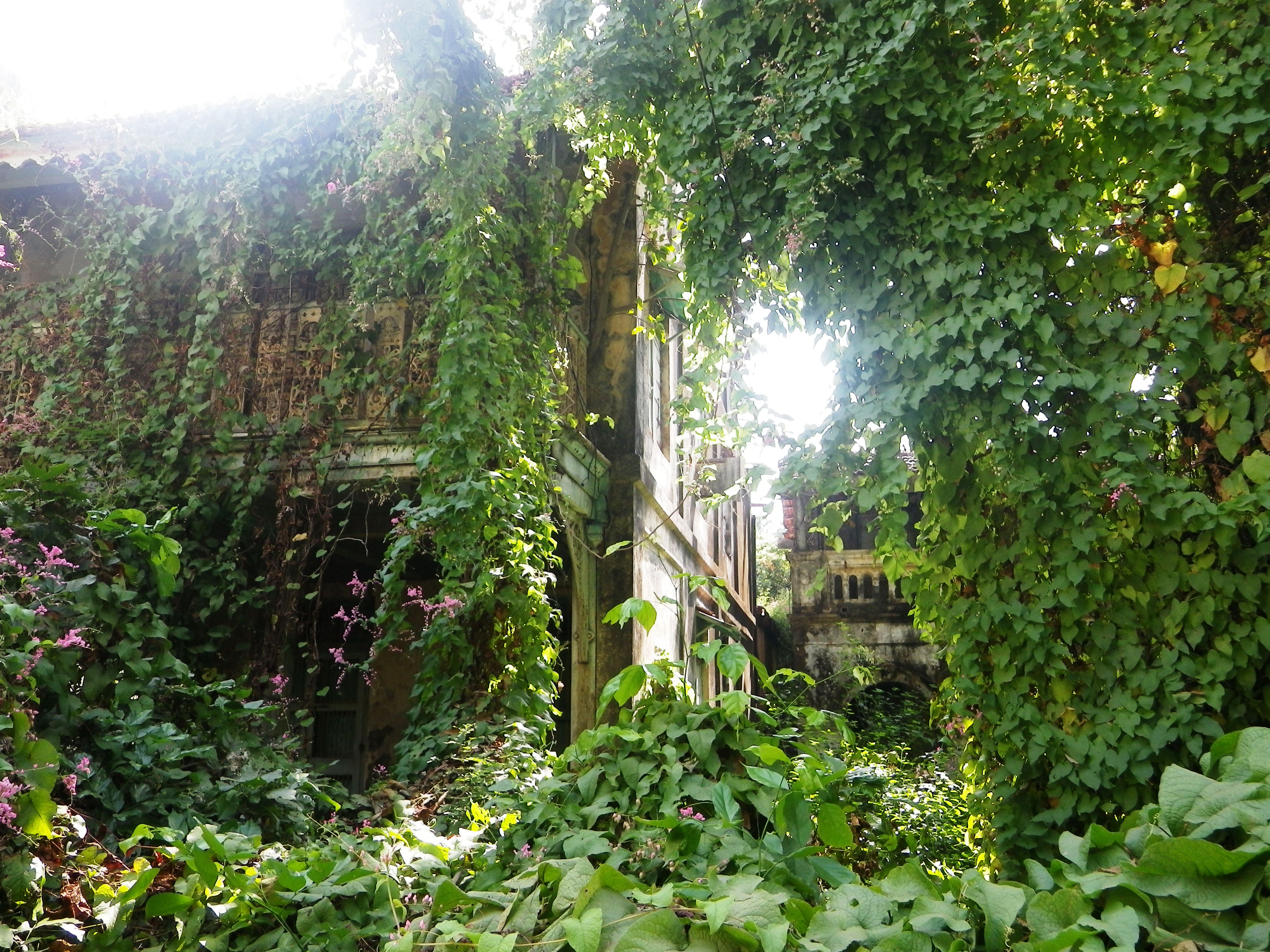
An abandoned Parsi house in Udvada, now overgrown with vines.

Note: The following article was printed in the Navroze 2012 number of Jame-Jamshed.

Do Parsis lack a proper sense of history? It is a question that I have often wondered while traveling and conducting research across India in the past fourteen months. Our history and culture is as rich as that of any other community in India, yet we have, at least for the past few decades, not been very good stewards of them. A number of our libraries and institutions are badly run. There are whole collections of valuable books and related items that are gathering dust in Godrej cabinets—or worse yet, in the open air. Many of the old Parsi wads in our ancestral towns and villages are deserted and decayed. Our holiest site, the Iranshah Atash Behram, lies amidst houses of great historical and architectural value, many of which are abandoned and garbage-strewn.

This is not how advanced, educated communities are supposed to act. We can rely on no excuses such as poverty and lack of resources—indeed, it is becoming increasingly difficult across the rest of Indian society to employ these excuses. Institutions such as the BPP or Tata charities cannot provide all the necessary help or solutions. The responsibility for what is wrong—and the responsibility for making it right—rests firmly on each of our shoulders. We collectively need to do a much better job on protecting and preserving our past.

We have lost—and and are continuing to lose—far too much. During the 19th and early 20th centuries, Parsis turned out a prolific amount of books and journals, ran dozens of newspapers and magazines, and supported a number of literary and educational societies. We had satirical journals like Parsi/Hindi Punch, filled with comics that poked fun of both British and Indians; serious newssheets like Sanj Vartaman, where Mahatma Gandhi figured amongst contributors; and societies like the Gayan Uttejak Mandli, which contributed toward the Parsis’ reputation as aficionados of Western music.  Scant records of these survive. In many other societies, they would be preserved and treasured.

There are a number of institutions and people doing their bit to help. The K.R. Cama Institute has employed INTACH to preserve many of its priceless manuscripts and other holdings. Homi Dhalla of the World Zarathushti Cultural Foundation has, among other activities, helped rescue Jamsetjee Jeejebhoy’s home in Navsari and establish the Zoroastrian Information Centre in Udvada. Along with preservation architects, he is hoping to turn Dadabhai Naoroji’s family house in Navsari’s Katrak Wad, which was nearly leveled by developers some years ago, into a proper memorial and museum. Shernaz Cama’s Parzor Foundation has, for years, labored to bring international attention to Parsi culture and has helped make the Meherjirana Library one of the jewels of our community.

These institutions and people need our active help and support. Yet I have been disappointed at how many Parsis display apathy and disinterest toward efforts to help preserve their culture. At the 2010 North American Congress in Houston, for example, I—perhaps too enthusiastically—showed a relatively affluent audience a check I had made out to Parzor for US$300, about one percent of my annual salary, and stated that if others who were far wealthier than I could do the same, then we as a community could truly do some good work with regard to protecting our heritage. If I remember correctly, my appeal generated a grand total of two checks—both for amounts much less than $300.

Let us begin with an obvious way to help protect our history. Many Parsi households have collections of old, rare Gujarati books on Parsi culture and the Zoroastrian religion, copies of old newspapers, and family trees. I have spoken with individuals who even have handwritten papers and letters of ancestors who were administrators in princely states, actors in Parsi theater, and merchants in East Asian trading outposts. Unfortunately, since many Parsis in my generation have limited or no Gujarati reading skills, they are considered of diminished value and are often rubbished. More than one elderly Parsi has offered me priceless Gujarati texts, telling me, “if somebody does not take this, my children will surely throw them away.”

For God’s sake, do not throw away such material. Old books, papers, letters, and other articles are of infinite value to historians such as me and, more importantly, future generations of Parsis and non-Parsis who will want to know about our rich past. Due to inexcusable carelessness and negligence, we have already lost papers of eminent Parsis such as Dinshaw Wacha and B.M. Malabari, personal items belonging to Dadabhai Naoroji, and the stories of countless other Parsis who have contributed toward both the community and India. We cannot afford to repeat these mistakes again.

Parzor is keen to collect artifacts of our heritage. I would like to highlight some recent donors to Parzor’s growing collection. Freny Ginwalla of Ahmedabad has donated handwritten hakim recipes—antidotes for afflictions ranging from dizziness to cholera—penned by a relative in Rangoon in 1925.  Meher Medora, also of Ahmedabad, has given a Vakil family album. Banoo Merchant of Mhow arranged for around 15 thick volumes of Parsi Avaz to be shipped to me in Bombay—these will also be donated to Parzor. Freny Sethna of Juhu is donating several volumes of Stree Bodh, a journal from the late 19th century meant to promote female education, that were lovingly preserved by her mother.

These individuals’ actions are to be commended—and emulated. If you or others are

unable or unwilling to keep similar items in your own family collections, I implore to please contact Parzor or other organizations and make a donation. You will do a great favor to your community.

Contact Dr. Shernaz Cama of Parzor at shernazcama@hotmail.com, 9810007717 or 011-2411-4794, or write to her at C-53 Anand Niketan, New Delhi 110021. 

India’s Troubled Archives and Libraries

India's history is literally rotting away in libraries and archives across the country.

The New York TimesIndia Ink has just recently published four pieces that I have written on the state of libraries and archives in India:

I: In India, History Literally Rots Away

II: Repairing the Damage at India’s National Archives

III: How Did Things Get This Bad?

IV: The Parsis, Once India’s Curators, Now Shrug as History Rots

For a country that is legitimately proud of its rich civilization, India can be remarkably callous about how it treats its history. Archives and libraries are, of course, only one aspect of what is in danger: one only has to visit other historical and archaeological sites in India to see how much heritage is being lost or is at perilous risk. It is hardly an understatement to say that, unless the Indian government gets serious about properly funding and staffing public archives and libraries, vast records of Indian history will literally turn to dust in the next few decades.

The problems associated with Indian archives are old. In the 1860s, the British Indian government became disturbed by the fact that Company records were rotting away and set up a special records commission. Allan Octavian Hume, who later went on to found the Indian National Congress, participated in committee proceedings. In 1871, he noted that, “Year by year the records are decaying; and unless some measures be adopted, it will, before very long, be found that, like the defunct Commission, the subjects of their investigations have dissolved themselves.” He urged the immediate publication of as much material as possible. Over 140 years later, as the historian S.R. Mehrotra remarked with disappointment, we face the same imperative: if conditions in Indian archives and libraries do not improve, then the only way to save important records will be to publish, photograph, or scan  them. A much cheaper and efficient method would be, of course, to improve the conditions at libraries and archives.

The idea for this series grew out of conversations I have had with other scholars, both Indian and non-Indian, while researching at the National Archives of India in Delhi during the past year. Over lunches and teas, we would trade stories of our experiences in various libraries and archives across the country. As I have mentioned in my article series, the sorry state of many of these institutions, and the destruction that is going on within them, is an open secret amongst scholars. However, due to the very real fear of institutional or staff retribution, we scholars mostly stay quiet and keep our complaints and observations to ourselves.

WHAT CAN BE DONE?

In order for Indian archives and libraries to change, this attitude has to change as well. As scholars, we have a responsibility not only to craft history out of our sources, but also to make sure that those sources survive to be used by future generations. If we only go to archives and libraries to fetch out information for our own personal use—and shut out the egregious practices that are going on around us—then we fail in this responsibility. There is still a real risk in speaking out, but, over the past year, I have heard many admirable stories about scholars who have protested against bad practices and bad policies. In many cases, they have succeeded in getting change instituted—something that benefits all of us. In the Maharashtra State Archives, one Indian Ph.D. candidate from a British university alerted the director that staff were retrieving bound 19th century newspaper volumes by flinging them off 15 foot-high shelves. In the West Bengal State Archives, a British Ph.D. candidate helped reverse the institution’s policy against using laptops (see more below).

It is my earnest hope that this series prompts some discussion, both amongst scholars and within the Indian government, about why so many archives and libraries are in terrible condition, and what can be done to change this sad state of affairs. Below are just a few suggestions on what needs to change:

  • Climate control: It is high time that 21st century India move beyond having libraries and archives that are open to the elements. Many British-era institutions remain in structures that have been hardly modernized or improved since they were built. Enclosed, climate-controlled structures will greatly cut down on weather, insect, and animal damage, leave alone providing more comfortable working conditions for scholars and staff.
  • Reevaluation of preservation policies: Methods of preservation in Indian archives, especially those involving the process of lamination, have often been disastrous. I have seen whole series of records at the National Archives, Maharashtra State Archives, and elsewhere that are now barely legible due to lamination. Lamination not only cuts down significantly on readability; the material also warps, discolors, and becomes brittle over time. The R.C. Dutt Papers at the National Archives are a travesty: on top of being laminated, these papers were bound into volumes (and occasionally bound out of order). I have been disturbed to hear staff in the National Archives talk about the same methods of preservation for the Dadabhai Naoroji Papers and have submitted a memo to the director strongly cautioning against this.
  • Staff training: Archives and libraries continue to function largely on the backs of “peons” or “boys.” These individuals, while doing vital work such as retrieving files and cleaning premises (in addition to making tea and doing countless other errands for staff), are given shockingly little training by their superiors. Steven Wilkinson, a professor of political science at Yale, observes that, “Not much of an effort is made to educate the lower-ranking staff on the importance of the documents and their careful handling.” I have seen this first hand: Dadabhai Naoroji’s letters scattered on a dirty floor so that a “peon” could find the specific files I requested. Superior officers need to be held accountable for training and monitoring the staff under them. As Wilkinson continues, it is very nice to be served namkeen and chai at your desk, but this “demonstrates something about the archival culture.” The bottom halves of staff hierarchies need to become invested in the mission of the archives.
  • A meritocratic culture: A professor at the University of Mumbai recounted how the university’s Kalina library benefited from a diligent assistant librarian who was keen on digitizing and better preserving some of the institution’s oldest holdings. She took the initiative to purchase equipment and develop long-term plans for the library. What was the reward for her initiative? The University of Mumbai’s head librarian demoted this assistant librarian to a third-rate college in the suburbs: her diligence and motivation were upsetting work patterns and was considered a nuisance. Such stories are not uncommon. In both public and private institutions, initiative and hard work need to be rewarded: these should be the factors for promotion rather than age or personal grudges.
  • Recruitment of qualified staff members: It is a miracle that, in spite of abysmally low pay scales and maddening bureaucracy, state-run archives and libraries retain so many qualified and dedicated staff members. There needs to be more of them, especially at the top. This requires a degree of bureaucratic reform and autonomy which the government is probably unprepared to allow. Hiring at government institutions is a centralized bureaucratic affair, oftentimes with an unhealthy dose of political interference. A deputy director at the National Archives recently informed me that it can take up to a year for a prospective employee’s file to make its way back to his desk from the central public services authorities. India produces no shortage of highly qualified historians, archivists, and curators. It is no mystery why so many of these individuals flee abroad to institutions that are better run, more meritocratic, properly funded, and not beholden to a sclerotic government bureaucracy.

The last few steps will contribute to perhaps the biggest required change in Indian archives and libraries: a change in mentality toward facilitating free research. As one Ph.D. candidate from the University of Chicago noted, neither institutions nor the government of India encourage an atmosphere of open inquiry for researchers. Foreign scholars must have their projects vetted by bureaucrats before they travel to India on research visas. All too often, institutes go out of their way to deny scholars, whether they are Indian or non-Indian, access to materials. Many librarians and staff members treat their institutions as personal fiefdoms and act as gatekeepers and regulators of information. This is a long distance from the model practiced elsewhere: that of librarians and administrators encouraging and facilitating free research. The Right to Information Act is changing the way things are working in Indian institutions. Let us hope that this also changes the way that many librarians and archivists understand their job responsibilities.

A volume of the Times of India from the 1870s, now reduced to shreds.

THE GOOD AND THE BAD

In the course of my research for this article series, I have visited and heard about several excellent institutions, as well as several disastrous ones. Here is some information about libraries of which India should be proud:

  • Forbes Gujarati Sabha: This small library in Juhu in Bombay contains a treasure-trove of Gujarati books and periodicals. Forbes is actively taking steps to preserve its material: aside from constructing a special chamber to mitigate the high acid content of Indian paper used in books from the 19th and early 20th centuries, they have digitized a large number of books and journals. One of Forbes’ trustees is Deepak Mehta, who had several decades’ experience in the Library of Congress’ India operations. Murali Ranganathan, a Mumbai-based independent researcher, is correct to describe Forbes as “easily the most excellent collection of Gujarati 19th century periodical material and books in Mumbai. The new air-conditioned premises, he adds, “are a cut apart from the library atmosphere of Mumbai.”
  • Institut de Chandernagor: This library, located in the former French possession of Chandernagore just north of Calcutta, has around 18,000 volumes, including rare French works. The institute includes Chandernagore-Pondicherry correspondence, which sheds light on French Indian trade in the 18th century. This correspondence has now been digitized and copies are available to scholars for a fee. Its director, Rila Mukherjee, is also a professor of history at the University of Hyderabad. “While I agree with you about the sad state of affairs in Indian libraries and archives,” Mukherjee recently wrote to me, “I should also point out that the small libraries and archives are already making the change.”
  • Sabarmati Ashram Library: As I mentioned in my article series, this library in Ahmedabad, the primary repository of Mahatma Gandhi’s papers, has kept its holdings in a sealed, temperature-controlled environment. They have also digitized their collection, which includes letters to Gandhi (not included in the Collected Works of Mahatma Gandhi series). Scholars can use a comprehensive computer index of the holdings, access the scans, as well as purchase copies for a nominal fee, inside the library. I have used the library twice and have found staff members to be exceedingly helpful, friendly, and knowledgeable.

There are many other excellent institutions across India. Sadly, most of the feedback I received was regarding libraries and archives that are in terrible condition. Three of the most egregious cases of neglect and destruction are outlined below:

  • Patiala State Archives:  In January 2003, The Tribune of Chandigarh reported (here and here) how the government of Punjab took all of the archival records out of its premises—including material from the Khalsa durbar; eight princely states including Patiala, Kapurthala, and Faridkot; Patiala and East Punjab States Union (PEPSU); and around 35,000 books—packed them into tractor trailers, and dumped them into buildings at the Punjabi University. As a result, countless documents were damaged and a meticulously organized collection was literally scattered to the wind. Papers slipped out of their files and material was exposed to moist weather and possibly termites. Apparently, the task of organizing just the princely state papers had taken 33 years—in the span of two weeks, this multi-decade effort was completely undone. “The labour of years in cataloguing the records has thus gone [to] waste due to the criminal negligence of a few officials,” The Tribune noted. This hasty move prompted condemnation from the Indian Council of Historical Research. The motive behind the move was to vacate the archives’ premises—Rajindra Kothi, a heritage structure—for an art exhibit. However, the Punjab government subsequently decided to convert Rajindra Kothi into a heritage hotel. Shilpi Rajpal, a doctoral candidate at the University of Delhi, visited the archives in 2011 and reported that they are now located in a government building. The files were still—eight years after their hasty transfer—unorganized. One helpful staff member, Rajpal notes, did help her sift through the bundles in order to find the files she wanted to consult.
  • Tamil Nadu State Archives:  Getting access appears to be a particular headache at this institution. Foreign scholars are required to present proof that they have been permitted to access records at the National Archives of India in the last six months; otherwise, they must present a “certificate of proof,” indicating that the government of India has approved their research project. A legal historian from the United States reported waiting two weeks for permission to consult 18th century manuscript records; ultimately, he was only given permission to access printed materials.  One scholar from the United Kingdom reported that conditions in the archives have deteriorated in the past five years, with many files having gone missing. One of his colleagues had to hand out small bribes in order to get files. Monsoons present another hazard. One Ph.D. candidate from the United States reported having visited the archives in October-November 2005 while completing his M.Phil from Delhi: he found the compound “routinely flooded during the monsoon season. Sometimes, this meant that the archives were closed entirely, and sometimes open for a more limited period during the day.” After one particularly rainy day, he noticed staff members hanging a clothesline on the archives’ verandah in order to dry out soaked archival documents.
  •  West Bengal State Archives: There was not enough room in my article series to highlight all of the shocking stories about this institution. This is particularly saddening: one scholar from a Southeast Asian nation argued that the WBSA is one of the most important archives for the study of India and the Straits Settlements. “The materials are gold!” he remarked. “There must be a global effort to preserve or at least digitize these materials swiftly as a fire would destroy one of the greatest repositories of 18th-19th century historical materials in the world.” For the moment, conditions are dismal. As one Ph.D. candidate from the United States expressed it, “you can literally see the silver worms crawling through [the documents].” Faridah Zaman, a Ph.D. candidate from Cambridge, notes that the indexes list whether documents have sustained damage by water, rats, or white ants, and that sometimes all three categories have been ticked off. Zaman visited the Writers Building branch, which houses 20th century documents, and noted that it took a week-and-a-half to just get permission to use the archives since the director was sick and only he could affix his signature. While waiting for her permission to come through, Zaman took out her laptop, immediately causing panic among the staff since laptops were not allowed on the premises. She stood her ground and, after some communication amongst staff members, was told that the director (presumably from his sickbed?) had now allowed the use of laptops, though only when consulting pre-1947 material. So here is one small victory: scholars no longer have to write out everything in hand. When Zaman visited the Shakespeare Sarani unit of the WBSA, however, an assistant director told her that she could still not use her laptop here.

So much for archival institutions. Many of our colleagues face an even greater challenge: working in non-traditional archival collections such as those in small temples, government offices, and medical institutions. The problems here can be legion. In the 1990s, Steven Wilkinson saw documents from the Uttar Pradesh Secretariat (Sachivalaya) library in Lucknow that had been dumped and burned outside. The library included rare books, gazettes, settlement reports, and other printed materials that Wilkinson had been unable to locate elsewhere. In 2008, Shilpi Rajpal became the first scholar in eight years to get access to this library. She found the remainder of the library’s holdings packed up in bundles, waiting for disposal. Rajpal, who is writing a dissertation on mental asylums in northern India, also had great difficulty convincing administrators in these institutions to let her consult their records.

DISSEMINATING INFORMATION ONLINE

With some rare exceptions, Indian libraries and archives have placed very little information online about their holdings, policies, or even contact details. India is a long, long way away from having something like the United Kingdom’s Access to Archives, a comprehensive website that lists specific holdings of many institutions in the country. But concerned scholars have been filling in the gap. A team of Indian academics have started Archive and Access, which features articles on specific archives as well particular challenges, such as the difficulty of accessing post-independence material. SAGAR, a South Asian graduate student journal run from the University of Texas, Austin, features helpful “archive reviews” on its website. The University of Chicago’s Digital South Asian Library operates the Libraries and Archives in South Asia Wiki, which has a comprehensive list of most institutions of interest to scholars. Recently, the American Historical Association started a similar wiki for India; the AHA has been encouraging historians to contribute.

I will be contributing my bit to this online presence. In upcoming weeks, I will be adding to this website some guides to institutions with which I am familiar, such as the National Archives of India, Maharashtra State Archives, and smaller institutions such as Mumbai’s K.R. Cama Oriental Institute and the library of the Bombay Parsi Punchayet. These guides will be kept open access and can be incorporated into wikis. I encourage other scholars to message me with further information about particular institutions: I will be happy to post your observations and insights.

Stay tuned.

UDVADA, PART 3: An Interview with Dasturji Khurshed Dastoor

Dasturji Khurshed Dastoor, High Priest of Udvada, speaks about the Udvada land controversy case, how he and his family have been affected, and what Parsis can do to help Udvada.

The Gujarat Revenue Tribunal has issued a ‘status quo’ order in the Udvada land controversy case, temporarily suspending Nucleus Developers’ ability to develop the property. Is there still an immediate danger to Udvada?

Yes. If the Revenue Tribunal eventually rules in Nucleus’ favor, they can begin building immediately. Even if the tribunal does not rule in their favor, Nucleus Developers can still move the Gujarat High Court. The stakes are high. Nucleus could also break up the 168-acre property into smaller holdings, something that would make it much more difficult to stop development.

Right now, we have the support of the government of Gujarat, but if the government changes, this support could vanish.

What can Parsis do to help the Udvada Samast Anjuman?

Parsis need to stop listening to and spreading rumors about the case. There have been a lot of rumors and inaccurate accounts that have been floating around on the internet. For example, one such rumor is that the Udavada Samast Anjuman once owned the land in question and is now paying the price for its decision to sell it off. However, the anjuman never owned the land—a portion was owned by a separate trust call the Shree Bagh-e-Iran Trust. The Udvada Samast Anjuman has publically released several statements on the case and these are authoritative. But the spread of rumors has exacted a toll on the anjuman’s cause. In order to protect Pak Iranshah, we as a community need to show unity rather than divisiveness.

How do local Udvada residents feel about Nucleus Developers’ project?

The whole of the local Udvada population is now behind us. This was not always the case. Last Republic Day, representatives from Nucleus Properties were welcomed by panchayat officials at the flag-raising ceremony at Jhanda Chowk. I was originally barred from speaking at a gram sabha meeting scheduled for 7 February 2011. In response, I began approaching local organizations and committees, such as the machimar (fishermen) sabha, and I explained the negative impact that the project would have on Udvada’s infrastructure and fragile environment. By the time that the gram sabha meeting finally took place, by the grace of Pak Iranshah, villagers indicated their support for the Samast Anjuman and their opposition to Nucleus’ plans.

How have you been personally affected by the case?

Nucleus has accused me of wanting to stop their development so that we can bring in a Parsi buyer and make a profit on the land. They have also issued several verbal threats to me and my family as well as to Parsi supporters of the Udvada Samast Anjuman.

Fighting the case has been very taxing on my family and me, especially since I have to travel frequently to Ahmedabad and Valsad. Luckily, the anjuman has had a number of strong supporters. Behram Mehta of Aava Water has been instrumental in helping us in Ahmedabad with matters that involve the state government. Maneck and Eric Toddywalla have provided crucial local support in Udvada. Rustom Marshall has been providing his able assistance as our legal representative. Architects Jamshed Bhiwandiwalla and Pankaj Joshi have been working to provide infrastructure for saving Udvada’s unique Parsi heritage.

What is being done to protect the sanctity of Udvada for the long-term?

A special body, the Udvada Development Authority, was created in March 2011. The body has the authority to regulate development in the village. I represent the Samast Anjuman in the Development Authority, and the other members include the village sarpanch and a town planner. The village has been divided into three zones: the vicinity of Iranshah, which has been given the highest priority for regulating development; a buffer zone around this core region; and the peripheries.  All the Parsi-owned houses around Iranshah have now been graded for their heritage value. These can no longer be legally demolished without the approval of the authority.

Individual Parsi community members need to also do their part to preserve and protect Udvada. Many Parsis have property in Udvada but their houses are empty and in a state of complete disrepair. They have a responsibility to preserve these traditional houses, come what may. It is our heritage and it is a prerogative. It is not that expensive of a task.