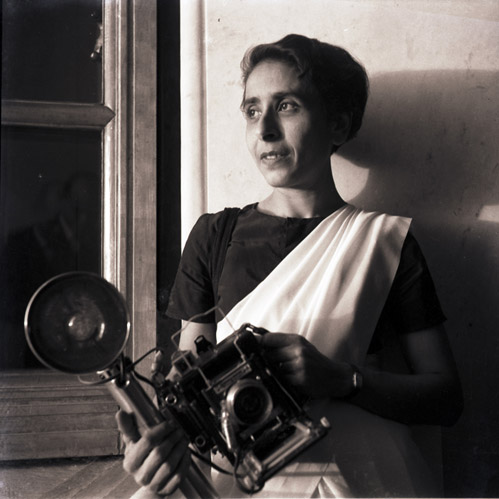
Remembering Homai Vyarawalla: An Interview in Boston

Homai Vyarawalla, India’s first woman photojournalist, passed away on Sunday at the age of 98. Vyarawalla is a significant figure for any student of modern Indian history: pick up any book covering Indian politics for the period from the 1940s to the 1970s and you will find at least a few of her photographs.

I met her only once. In May 2008, when Vyarawalla was a sprightly 95, she traveled to London, Boston, and Chicago along with her biographer, Sabeena Gadihoke, for a lecture tour. It was her first trip abroad. She spoke briefly at a lecture at Harvard University’s Sackler Museum after Gadihoke delivered a lecture on her pioneering work. Below are some of my reminisces of her visit.

On 8 May, I helped organize a dinner in her honor with the Boston Zoroastrian community. While Gadihoke was visibly suffering from jetlag and nodding off to sleep, Vyarawalla was alert, relatively talkative, and quite enjoying drinking a Coke. She responded in a no-nonsense fashion to the questions put to her by the attendees. Did she have any message to give to enterprising Zoroastrian women, somebody asked. “No,” she responded. When we gave her a picture book of Boston as a gift at the end of the dinner, she looked at it and then politely handed it back. “What use will I have for it?” she asked us. From the little I got to know of her that evening in May, it was abundantly apparent that Homai Vyarawalla was part of a now all-but-vanished part of the Parsi community: those who knew real poverty and grew strong from the experience, exercising extreme frugality and self-reliance in all aspects of their lives.

Before we went to dinner, I had a chance to talk to Vyarawalla in her hotel room in Harvard Square. She told me that was enjoying her trip and liked how Boston was so clean in comparison to India. I asked her a little bit about her family background. Vyarawalla was related to the priestly Meherjirana family of Navsari but she grew up in Tardeo in central Bombay. Her mother wove kustis, which took about eight days to make, and sold them for Rs. 3½ each. “We were in abject poverty yet we were happy and healthy,” she remembered. Later, she was admitted to St. Xavier’s College, where the tuition was a princely Rs. 72 for three months.

As Gadihoke’s book did a good job covering her experiences interacting with various world leaders, I asked her about some more obscure matters, such as what she remembered from her childhood (it is not every day, after all, that you can meet someone who remembers the 1920s). She had some memories of the Prince of Wales Riots that broke out in Bombay in November 1921, when Vyarawalla was a schoolgirl. These were the last major riots where Parsis were participants; it is one chapter in Parsi history that the community has chosen to forget.

Late in November of that year, the Prince of Wales visited Bombay and, in keeping with the non-cooperation movement, Mahatma Gandhi and the Congress party called a hartal or strike. A number of Parsis and Anglo-Indians broke the hartlal, attended ceremonies for the prince’s arrival, resulting in them becoming the target of Hindu and Muslim mobs over the next few days. Vyarawalla recalled that many Parsi schools staged garbas on the day that the prince arrived at Apollo Bunder. Hindu and Muslim Congress supporters, she continued, spread rumors that the Parsis were against Indian independence and, in particular, targeted the Parsis’ involvement in the liquor trade. She remembered a liquor shop in Tardeo being pelted with stones by rioters. Hindu and Muslim rioters had only these stones, lathis, and aerated soda bottles as their weapons—though Vyarawalla noted that the marble stoppers used in the bottles could be especially deadly projectiles. Parsis had more options at their disposal: she remembered that a Parsi police supervisor provided brickbats to Parsi rioters on Wadia Street, who had also dragged out desks onto the streets to be used as barricades.

Perhaps these early memories of nationalist-inspired violence influenced her political views. Vyarawalla said that she studiously avoided politics and political movements—somewhat ironic, considering that she captured on camera some of the seminal political moments in the nationalist and post-independence periods. Regular people, she noted, could not afford to be involved in politics; only wealthy people such as the Captain sisters, Dadabhai Naoroji’s grandchildren, could. Gandhi was “a show.” “I would not call him a Mahatma,” she argued. How did Gandhi have any authority to tell men to go to their deaths in order to achieve Indian independence? This left many broken and grieving families, she noted. Vyarawalla had slightly more positive views about Nehru.

Vyarawalla was downbeat on the Parsis. “Parsis are always lazy,” she complained. The Parsis had lost their sense of pride, and how could the community survive when this had departed? Charity, she believed, had done the most harm to the community. Vyarawalla recalled that she used to give money annually to around eighteen families in Baroda, but she stopped this practice once one family demanded in writing that this dole be given early. She now isolated herself from Parsis in Baroda, where she lived.

With that, I ended the interview and she invited me to visit her in Baroda the next time I was in town, although she warned that the children living next door were particularly loud and rowdy. I did not get a chance to meet her again. But her humility and frankness has left a very strong impression on me.

Dinyar Patel


Further Reading:

Sabeena Gadihoke, Camera Chronicles of Homai Vyarawalla (Parzor, 2006). Click here for ordering information. See a review by Shyam Benegal, published in Outlook, here.


Doubt: Descartes and the Gathas

René Descartes, the seventeenth century French philosopher considered by many to be one of the founders of modern European rationalism, was troubled by doubt.  What if, he wondered, everything that I see, hear and touch is not fundamentally, really real?  What if everything I know, or think I know is false and even the truths of mathematics and physics, which seem entirely unshakeable, are clever lies and not universal laws?  Descartes confronts his doubt in a book he called Meditations on First Philosophy, composed in 1640.  At the beginning of the First Meditation, Descartes lays out his program:

Some years ago I was struck by the large number of falsehoods that I had accepted as true in my childhood, and by the highly doubtful nature of the whole edifice that I had subsequently based on them.  I realized that it was necessary, once in the course of my life, to demolish everything completely and start again right from the foundations if I wanted to establish anything at all in the sciences that was stable and likely to last.

Descartes begins his demolition work by acknowledging the ways in which the senses can be deceived while awake and the impossible visions that come to people when they sleep.  However, even if one’s perception can be called into doubt in these particular circumstances, the fundamental truths of the universe—meaning arithmetic, geometry, the laws of physics and the like—would still hold.  Even while asleep and dreaming, Decartes writes, two plus three makes five, never four or six.

However, the meditation goes further.  For who is to say if these laws, the world, the sky and the sun, the whole universe, do not really exist but that it is God who makes them appear to exist?  How can one know for certain that God himself does not contrive things so that one goes wrong every time one adds two and three?  God’s good nature renders unlikely this kind of malicious trickery and makes Decartes’ doubts themselves doubtful.  In order to reach his desired state of radical doubt, in which he can call into question everything he accepted, by habit, to be reality, Descartes makes use of a convenient fiction:

I will suppose therefore that not God, who is supremely good and the source of truth, but rather some evil demon (sed genium aliquem malignum) of the utmost power and cunning has employed all his energies in order to deceive me.  I shall think that the sky, the air, the earth, colors, shapes, sounds and all external things are merely the delusions of dreams which he has devised to ensnare my judgement.  I shall consider myself as not having hands or eyes, flesh or blood or senses, but as falsely believing that I have all these things.  I shall stubbornly and firmly persist in this meditation; and, even if it is not in my power to know the truth, I shall at least do what is in my power, that is, resolutely guard against assenting to any falsehoods, so that the deceiver, however powerful and cunning he may be, will be unable to impose on me in the slightest degree.

From this position of radical doubt, in which he presumes that an evil force has directed all his energies merely in order to trick him, Descartes ultimately arrives at bedrock that he knows must be true.  This is the famous dictum cogito, ergo sum, I think therefore I am.  Whatever else happens, even if all his thoughts are false delusions, the fact that he is thinking cannot itself be wrong.  The evil demon is directing his energies at deceiving something and that something is him, Descartes.  The thought I exist can, therefore, never be false, however much the demon applies his energies.

What interests us here, though, is not the rationalist method Decartes builds from that moment of radical doubt.  To a Zoroastrian ear, the notion of an evil demon has a familiar ring.    Is Decartes not, somehow, reflecting the belief in the existence of the evil spirit, whose existence is entirely opposed to the good and who corrupts the world and deludes people’s beliefs and senses?  The parallel is not entirely accurate of course: Descartes’ evil demon is more reminiscent of the gnostic demiurge, that evil being who created the world solely in order to torment human beings, while the good, true God stands outside and beyond the world.  In the Zoroastrian conception, the world itself is inherently good, it exists (as do we) and our perception of it is to be trusted.  The evil spirit corrupted the world in his attack on it, evil and good have become mixed but the tradition does not embrace an ontologically dualist vision of the world itself and humans’ mortal lives as inherently delusions.

Nevertheless, doubt is linked with the evil spirit in the Zoroastrian tradition.  Doubt is not only the result of the meddling of the evil spirit but the cause of the revelation of his existence.  As in Descartes’ Meditations, doubt is productive.  In my previous post I mentioned the role that doubt plays in launching the theological quest in the Shkand Gumanig Wizar and the Dadestan i Menog i Xrad.  However, doubt plays this role in the Gathas as well.  We can take, for example, the opening section of Yasna 29.  In the first stanza of the poem, the soul of the Cow complains to Ahura Mazda (in Martin Schwartz‘s translation in his article “Gathic Compositional History, Y 29, and Bovine Symbolism):

To you the Cow’s soul complained: “For whom

did You shape me?  Who fashioned me?  Fury

with force, violence with brazen vice have gripped

me with might; I have no pastor other than You,

so appear to me with good pastur(ag)e.”

The soul of the Cow, that ideal manifestation of bovinity in the heavenly sphere, is troubled by violence and without a protector.  In its pain, the soul of the Cow calls out for aid.  This plea is repeated by the members of the divine panoply: the Fashioner of the Cow asks Rightness (Asha) who he will appoint as the lord and protector of the Cow.  The Fashioner of the Cow replies that no champion is to be found (29:3): “there is no liberator, free of malice, on behalf of the Cow.”

Only Lord Wisdom (Ahura Mazda) can provide a protector.  In stanza five, the Soul of the Cow and the soul of Zarathushtra himself are described as standing with hands outstretched in supplication, asking:

“Is there no

hope for the right-living person, none for the

cattleman surrounded by wrongful ones?”

Ahura Mazda’s answer is, it seems at first, negative: no hope has been found in the world, no judgement in accord with Rightness.  But in next stanza Lord Widsom asks his own question.  Having created the “mantra of poured butter and milk for the Cow,” he asks Good Mind (Vohu Mana) if he has found someone who can deliver this beneficent mantra to mortals on earth.  Vohu Mana replies that indeed he has; as 29:8 reveals, the revealer of the mantra is none other than Spitama Zarathushtra himself.

But the Soul of the Cow is unsatisfied.  Is this the champion he pleaded for?

“I who have

(thus) gotten (on my behalf merely) the mightless

voice of a powerless man instead, (I) who wish

for someone who is dominant with might!  When

will there ever be someone to give him help of hands?”

In the final stanza, the poet answers this lament.  Zarathushtra’s hands are helped by the divine triad of Rightness, Good Mind and Lord Wisdom.  Through his revelation, the Prophet aids mortals, including the long-suffering cows, more than any herculean strong man.  “Take account of me,” he says to them, “come down to us here.”  It is Zarathushtra’s ability to channel and call upon the divine that settles the Soul of the Cow’s complaint.

There are two species of doubt in Yasna 29.  The first is the doubt exhibited by the Soul of the Cow.  We might call this kind of doubt existential: it is closer to worry or anxiety, doubt about the safety of cows and pasturage, about protection against marauding raiders.  This is of a different order than Decartes’ posulation of the evil demon.  The Soul of the Cow’s doubt is existential while Descartes is epistemological: he doubts not his own life and safety but his perception and understanding of the world.

What of Zarathushtra’s doubt?  When Zarathushtra portrays his spiritual self as standing with his hands outstretched beside the Soul of the Cow, he does not ask Ahura Mazda for his own protection.  Zarathushtra’s question is one with deep ethical implications: can there be justice?  Is there no recourse for wrongdoing?  The poet’s doubt is global, addressing the foundation of the order of the universe.  It is to his doubt that Ahura Mazda responds – and the Soul of the Cow expresses its dissatisfaction –  granting Zarathushtra his ritual and poetic mission.  Like Descartes, Zarathushtra’s doubt is the catalyst for revelation.